A brain for your AI workflow that keeps getting smarter, and mission control to run it.
Plan in one place. Build in many. Lose sight of nothing.
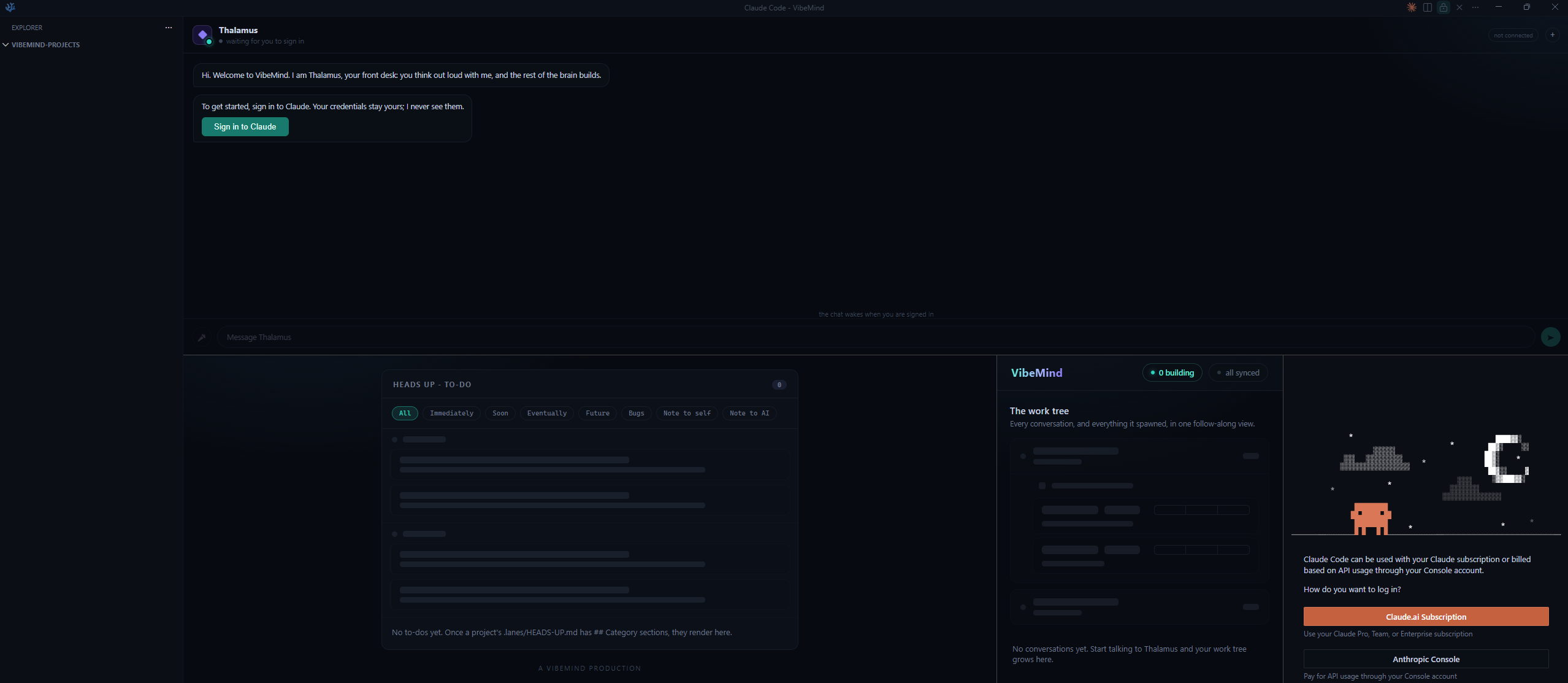
The cockpit, first boot: Thalamus, the work tree, the board. Real capture, no retouching.
Three things, plainly.
A brain: the curated memory and working rules your AI agents read the moment they start, so they boot already knowing your project. A machine: the coordination layer that runs several agents side by side and keeps them off each other's files. And an app that packages both, for people who do not want to live inside a code editor.
A public GitHub repository. Really.
Clone the repo, paste one block into your project's CLAUDE.md. That's the whole install: Thalamus greets you and runs the brain, an ASCII status board keeps score, and the working guidelines we compile from the sources we watch come baked in.
An app, and here is exactly what it is made of.
Built openly on VSCodium, running the genuine Claude Code extension, unmodified; you sign in directly with Anthropic, and VibeMind never sees, holds, or proxies your login. Around it sits the machine: the Board for every conversation and agent, lanes that keep parallel work from colliding, and a living brain kept current for you.
Shared org memory.
One brain every seat inherits: the decisions, rules, and instincts your whole team works from. Coming later.
- ▸You bring your own Claude account. A paid Claude plan or an API key; the free Claude tier has no Claude Code access.
- ▸The app is Windows-first today.
- ▸It works on your existing projects, as they are. No restructuring, no migration.
Thalamus, the Board, the work tree, the Mind. One screen.
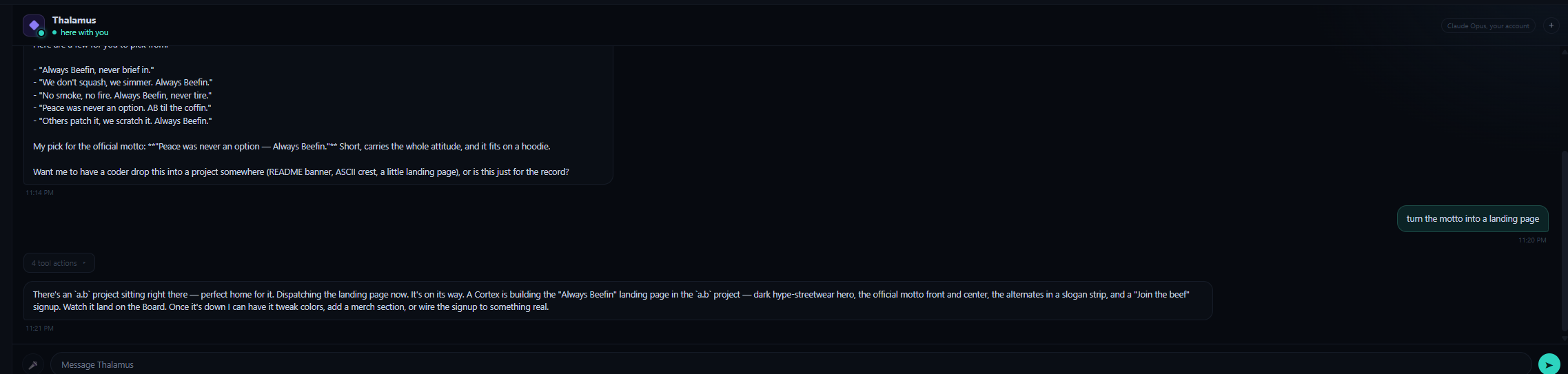
You talk to Thalamus like a person. Your builds run in isolated lanes, land on the Board, and nothing you started ever scrolls away.
A real Thalamus conversation: think it out loud, say go, watch the build land on the Board.
Three agents. One repo. Today, it just works.
Once you stop repeating yourself, you can run several ideas at once instead of one at a time. Every agent works in its own lane, a claimed set of files, so lanes make collisions impossible by construction.
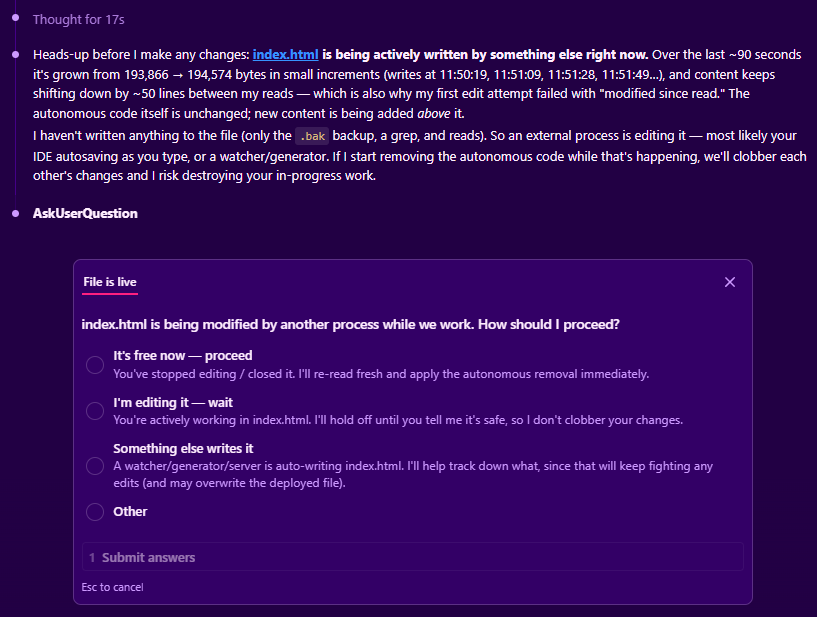
Real capture of life without lanes. This is not VibeMind. The agent notices something else writing the very file it is editing and stops dead to ask how to proceed.
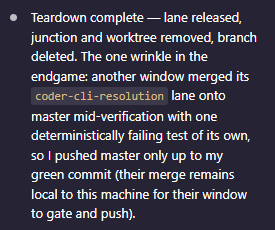
“I pushed master only up to my green commit... Their window owns the fix.”
During its own pre-push checks, one agent caught a failing test that a sibling agent had introduced, held that change back, and pushed only its own verified work. Nobody asked it to. The agents police each other.
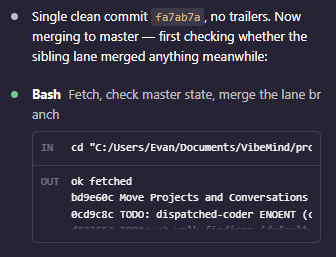
Before merging, each agent first checks whether a sibling moved the code underneath it.
Same run, another agent. Its commit is clean and ready, and its first move is still to fetch and check what the other two did in the meantime. That reflex is the discipline, built in.
Structure you barely pay for.
Disorganization is the expensive thing.
We ran 69 audited tests on real open-source codebases and spent $103.97 of real money to measure this. The short version: the organization layer adds almost nothing to your bill. The expensive thing is the disorganized default most people already run.
Weigh a price against the hours back
Every number here comes from real timed runs of real coding tasks, reported as ranges rather than single points. The dollars come out about the same as doing your tasks one at a time; what changes is how fast and how orderly the day runs. Full methodology in the receipts.
Medium codebase, five runs each, middle result reported. Every number, every caveat, every blank: on the receipts page.
Even the smartest models do not organize work this way on their own.
We handed the whole job to top-tier models nine times and watched what they chose. Not one of them split the work into parallel lanes or hired cheaper workers for the simple parts. Every one reached for the slow, expensive shape by default. The best strategy has to be encoded. The machine is that encoding.
Before our final test ran, this engine predicted its result within 8 percent. Full methodology on the receipts page.
The thread you are scared to close.
You know the one. Weeks of decisions live in a single chat: every architectural call, every dead end you already ruled out. It is the only record of how you got here, so you keep it open. And it degrades: the context fills, the answers wander, every turn costs more than the last.
The brain livesoutside the transcript.
VibeMind keeps decisions, rules, and project facts in durable memory, outside any chat. Closing a conversation costs nothing. A fresh one reads the brain and boots fully caught up.
Who carries the weight?
Nobody else keeps your project honest. The difference is how many times you have to say it: every single time, or once.
- ✕Explain the project rules. Again. To every fresh session.
- ✕Re-state last week's decisions to an agent that was not there.
- ✕Repeat the deploy steps to every new agent you spawn.
- ✕Tell each one what is already in flight so they do not collide.
- ✕Ask what actually got done. Every time. Then go check.
- ✕Walk every session through the TODO, or watch it go stale.
- ✕Ask for a report, file it yourself, then do it all again tomorrow.
- 01Still your project.
- 02Still your rules.
- 03Still your call.
Still your project. Still your call. The brain carries the bookkeeping.
The ground keeps moving.
The brain keeps up.
Anthropic ships new models, new features, new policies, new prices. You know you are not keeping up with all of it. You could. It is easier to let the club do it. The brain tracks the whole ecosystem, every claim linked back to its source, and hands you the new rule while it still matters.
Read the full changelog: 42 sourced entries, back to 2024
Three ways in.
Start free, in bare Claude Code, and feel the difference. Step up to the whole machine when you are ready.
- ✓A starter brain that works in bare Claude Code.
- ✓Thalamus, the front desk: it greets you and runs the brain.
- ✓A handful of commands to run with.
- ✓A simple ASCII status board.
- ✓Five-minute setup.
Clone it and go.
- ✓The app, for people who do not live in an editor.
- ✓The Board: every lane, report, and question in one view.
- ✓Parallel lanes that cannot collide on the same file, by construction.
- ✓Persisted reports that land and stay.
- ✓The needs-input queue, so nothing waits on a lost message.
- ✓The living brain, always current.
- ✓One brain your whole team reads and writes.
- ✓Decisions, rules, and instincts shared across everyone.
- ✓The bookkeeping, handled at team scale.
The homework is sitting right in front of you.
None of this is a secret. Anthropic prints it on the usage dashboard and writes it in the docs, freely available to anyone. Reading it is easy. Doing something with it, every session, while also building your product, is the hard part.
“54% of your usage was at >150k context – Longer sessions are more expensive even when cached. /compact mid-task, /clear when switching to new tasks.”
“33% of your usage came from subagent-heavy sessions – Each subagent runs its own requests. Be deliberate about spawning them – and consider configuring a cheaper model for simpler subagents.”
The club is us doing something with it, rapidly, as it lands: the guidance becomes working defaults in the brain, and the machine runs them so you do not have to remember to.
VibeMind just works like this.